
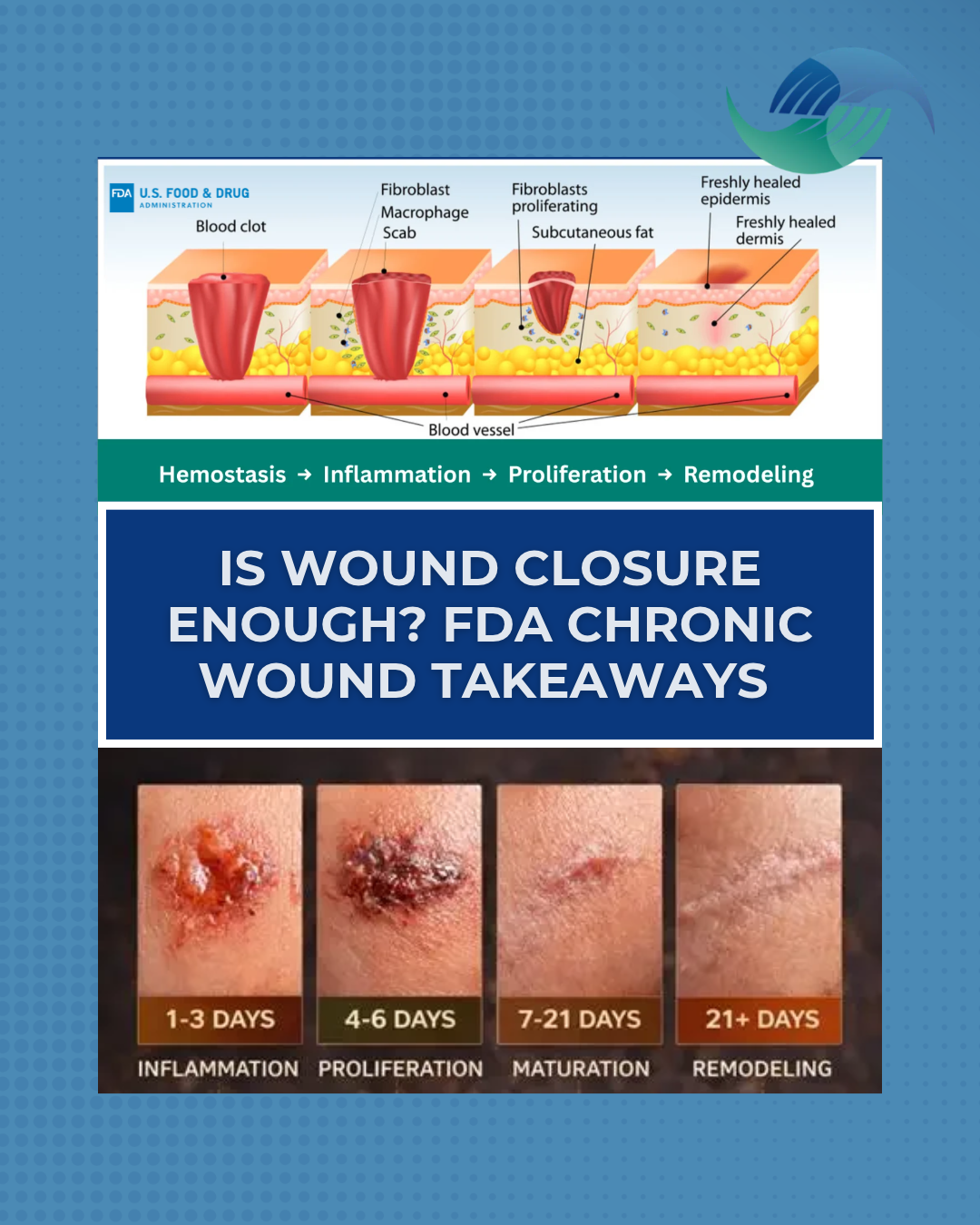
For a long time, the finish line in wound care was easy to spot. The wound closed, the skin was intact, and the patient was discharged. Anyone who has worked in a wound clinic also knows how often that same patient comes back a few weeks or months later.
In August 2026, the FDA held its first patient-focused meeting on nonhealing chronic wounds, and patients said a lot of what clinicians have been seeing for years. Closure matters to them. So do pain, mobility, sleeping through the night, and knowing the wound won’t open back up. So is closure enough? It’s a big step, but for most chronic wounds it isn’t the whole job.
What Happened at the FDA’s Chronic Wound Meeting?
The meeting took place August 25 in Silver Spring, Maryland, with an online option. Patients and care partners talked through three topics: how chronic wounds affect day-to-day life, what treatment has been like for them, and what they would want to know before joining a clinical trial. The FDA took public comments through October 26 under docket FDA-2026-N-5057, and its summary report hasn’t been released yet.
The meeting didn’t change any FDA rules. It did put patient priorities on the record with the agency that reviews new wound therapies, and that kind of input tends to influence how future treatments get studied.
Why Isn’t Wound Closure the Whole Story?
In a recent Wound Care University episode, Chelsea Thompson, CHT, EMT, CWCA, CWP, HBO Safety Director, described the old way of thinking well. Once a wound was fully epithelialized, you said goodbye. Then you saw the patient again, sometimes two weeks later, after a change in shoes or a stretch of poorly controlled blood sugar.
The topic picks up where an earlier episode left off. In that conversation, Chelsea and Dr. Marcus Gitterle, MD, FACCWS, CWS, co-founder and Chief Medical Officer of WoundCentrics, talked about what it really means to heal a patient, including when it’s appropriate to discharge someone and when it’s better to stay in touch.
It makes sense that closure became the target. It’s visible and easy to measure. The trouble is that a chronic wound is usually a sign of something else going on, and closing it doesn’t make that problem go away.
Venous leg ulcers. The wound is just the tip of the iceberg in these cases. When we discharge a patient at the point of skin healing, we fail to address the underlying vein disease that leads to recurrence in 70% of cases. By continuing to care for these patients, we can optimize factors that reduce recurrence risk, chronic pain, and improve mobility.
Diabetic foot ulcers. These challenging wounds can be healed, but often with prolonged, interdisciplinary care. Unfortunately, the very conditions that led to the wound, also make it very likely that the individual will experience a recurrence. By continuing to follow patients after skin closure, research shows that we can significantly reduce the chance of recurrence.
The numbers back this up. A New England Journal of Medicine review estimated that about 40% of patients develop another diabetic foot ulcer within a year of healing, and close to 60% within three years.
What Did Patients Say Healing Looks Like?
Several patients at the meeting described healing in ways that never show up in a wound measurement. One man with recurring leg ulcers asked the panel not to stop at pain and time to heal, and to remember that “recurrence matters as well.” Another participant said success should be judged by “how the patient is functioning and feeling, not only by how the wound looks” (FDA transcript).
When the audience was polled on which benefits of a new treatment mattered most, faster healing, quality of life and complete healing rose to the top, and the moderator called quality of life the biggest priority. The FDA was careful to say the polls weren’t a scientific survey. Still, the pattern was hard to miss.
How Could This Change Wound Care Clinical Trials?
Whatever a trial picks as its endpoint is what it ends up measuring. If the main goal is complete closure by a set week, the study is mostly measuring epithelialization. If the goal is a therapy that changes how the disease plays out over time, researchers will likely need to track more, such as:
Time to closure, and whether the wound stays closed
Recurrence, infection and hospitalization
Amputation
Pain and drainage
Function and return to normal activity
Quality of life
That’s a harder list to measure. It would also tell us much more about whether a treatment helped.
Closing the Wound vs. Treating the Cause
Here’s a point that sometimes gets lost: a product can help a wound close without treating what caused it. A cellular or tissue-based product may add a biologic effect. A good dressing can keep moisture balanced. Negative pressure therapy can help with drainage and granulation tissue, and an antimicrobial dressing can lower bacterial burden.
All of these have their place, but none of them fixes pressure, shear, neuropathy, edema or poor perfusion. So before deciding what goes on the wound, step back and ask why it isn’t healing. That usually starts with a thorough assessment, including a vascular workup.
Questions Worth Asking After “Did It Close?”
Next time you review a patient’s progress or look at a new therapy, try adding a few questions:
Did the wound stay closed?
Is the patient in less pain, with less drainage?
Can they do more than they could before?
Are they back to their usual level of activity?
Did we treat what caused the wound in the first place?
What did this treatment change about the course of the disease?
The last question is the hardest one to answer, and it’s probably the most important.
Where WoundCentrics Stands
Our physician-led programs look at the whole patient, not just the wound surface. That means blood flow, offloading, swelling, infection, nutrition, and the patient education that keeps someone on track after they leave the clinic. We’ll be watching for the FDA’s report and for how these patient priorities show up in future wound care research.
Final Thoughts
Finding products that close wounds faster will always be part of wound care. It just can’t be the only goal. The patients who spoke to the FDA talked about walking again, going back to work, sleeping, and not worrying about the next flare-up. Closed skin was part of that, but only part. It’s encouraging to hear that message reach the FDA, and we hope it shows up in everyday practice too.
Watch the Full Wound Care University Episode
This article is based on the Wound Care University episode “FDA Redefining Wound Healing” (7:50) with Chelsea Thompson. It’s a quick, worthwhile watch for anyone rethinking what success looks like with chronic wounds. For more clinician education, visit Wound Care University.
About the Educator
Chelsea Thompson, CHT, EMT, CWCA, CWP, is HBO Safety Director and a healthcare educator with a decade of experience. She began her career as an EMT with two county 911 EMS agencies, then worked as a certified hyperbaric technologist with WoundCentrics in San Antonio and New Braunfels. Today she serves as Wound Care University’s hyperbaric course administrator and presenter. Read Chelsea’s full bio.
Frequently Asked Questions
Q: Is wound closure the same as wound healing?
A: Not always. Closure means the wound surface has epithelialized. With chronic wounds, real healing also depends on whether the wound stays closed and whether the cause, such as venous hypertension, neuropathy, pressure or poor blood flow, has been treated.
Q: What was the FDA’s meeting on nonhealing chronic wounds?
A: On August 25, 2026, the FDA hosted its first FDA-led Patient-Focused Drug Development meeting on nonhealing chronic wounds. Patients and care partners shared how chronic wounds affect daily life, their experience with current treatments, and what they consider when deciding whether to join a clinical trial.
Q: Why do chronic wounds come back after they heal?
A: Chronic wounds often recur when the condition that caused them is still present. For diabetic foot ulcers, recurrence is estimated at roughly 40% within one year of healing, often tied to neuropathy, pressure, footwear, glycemic control, and vascular status.
Q: What outcomes matter most to patients with chronic wounds?
A: At the FDA meeting, patients emphasized quality of life, faster healing, complete healing, reduced pain, mobility, and preventing recurrence. Many described healing as getting their independence back.
Q: What should clinicians ask before choosing an advanced wound therapy?
A: Start by asking why the wound isn’t healing. Make sure blood flow, pressure, swelling, infection and offloading have been checked and addressed before counting on an advanced product to close it.
Talk With Our Team
If your hospital, LTACH or wound center is looking at how to get patients healed and keep them healed, our clinical leadership team would be glad to talk. Contact WoundCentrics.
Sources