
The Test Too Often Missed: Why Vascular Assessment Drives Chronic Wound Healing
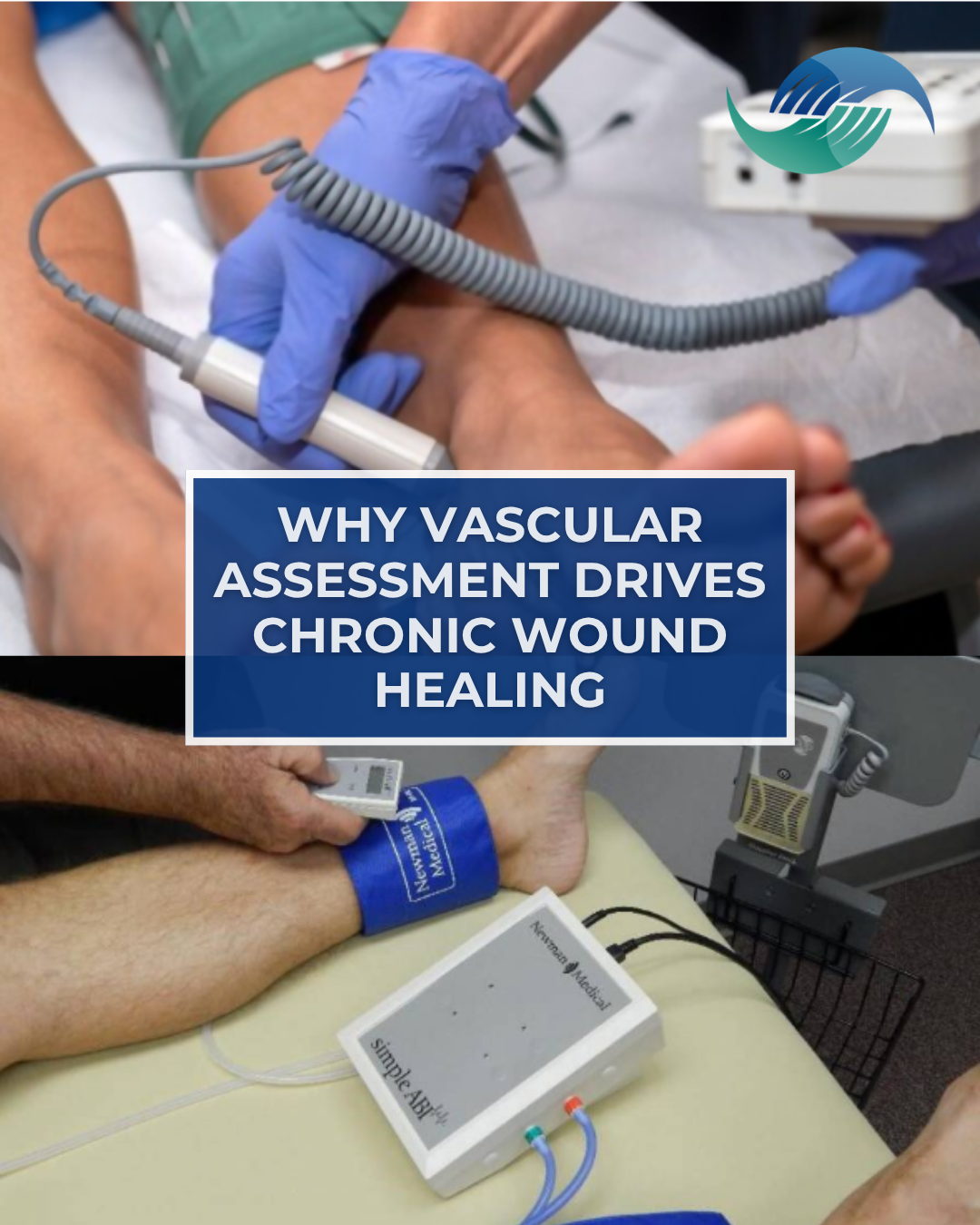
Vascular assessment answers the single most important question in chronic wound care: is there enough blood flow to heal? Up to 50% of patients with diabetic foot ulcers have undiagnosed peripheral arterial disease (PAD) at the time their wound is first evaluated (IWGDF Guideline on PAD, 2019), yet only a fraction of these patients are ever referred for definitive vascular testing. Without that testing, wounds that look like a dressing or debridement problem are actually a circulation problem — and no amount of advanced therapy will close a wound that isn't getting enough blood.
Why Do So Many Chronic Wounds Have Undiagnosed Vascular Disease?
Clinicians are trained to treat what they can see: the wound bed, the drainage, the surrounding tissue. What's harder to see is the arterial or venous disease underneath it. The landmark Eurodiale study, a multicenter European cohort of diabetic foot ulcer patients, found that PAD was present in 49% of subjects at baseline, and that one-third of patients had both PAD and infection simultaneously (Prompers et al., Diabetologia, 2007, via PubMed).
A decade-long follow-up study reinforced how much this gap matters: nearly all patients (all but one) who went on to a first major amputation had PAD at the time of their initial diabetic foot ulcer, and severe PAD (ankle-brachial index ≤0.4) was present in more than half of those amputation cases (Morbach et al., Diabetes Care, 2012, via PubMed). PAD was also one of the strongest independent predictors of death in that cohort, alongside dialysis and advancing age.
Clinical examination alone cannot rule this out. Palpating pulses and checking skin color are useful first steps, but the International Working Group on the Diabetic Foot (IWGDF) is explicit that clinical exam does not reliably exclude PAD in most people with diabetes and a foot ulcer — objective testing is required (IWGDF PAD Guideline, 2019).
What Does Vascular Testing Actually Measure?
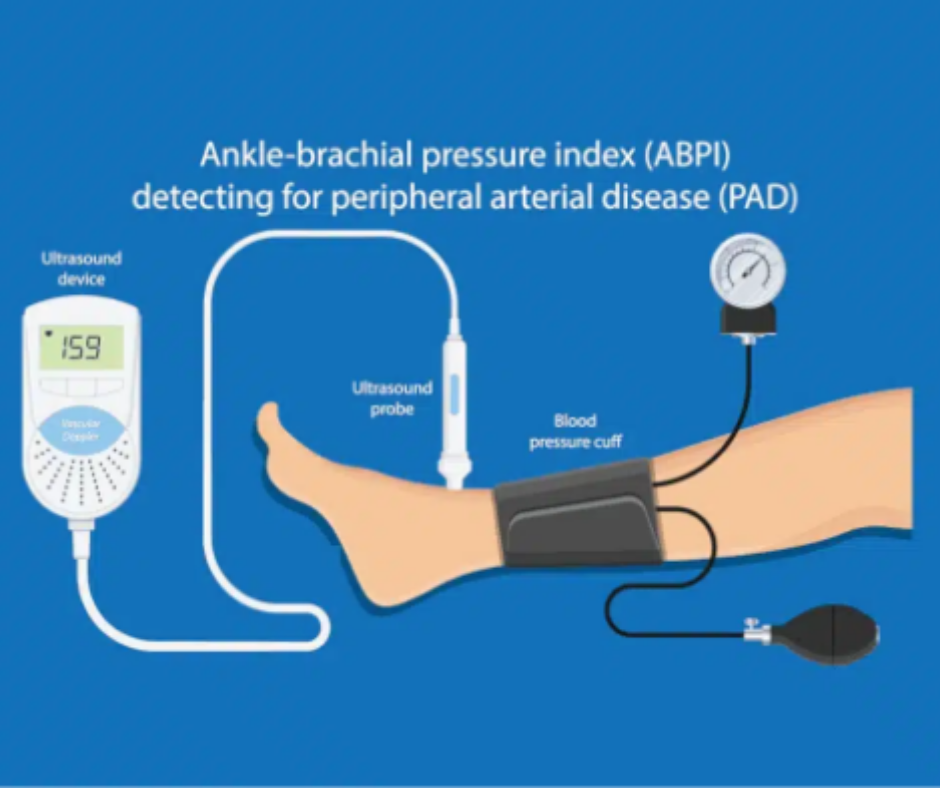
Noninvasive vascular studies exist to answer one question objectively: is perfusion adequate to support healing, or does blood flow need to be restored first? The core tools are:
Ankle-brachial index (ABI): compares systolic blood pressure at the ankle to the arm. A normal ABI falls between 1.0 and 1.4; a value at or below 0.90 is abnormal, and severe disease is indicated below 0.40 (American Heart Association).
Toe pressures and toe-brachial index (TBI): especially useful in patients with diabetes, whose calcified, noncompressible arteries can produce falsely normal ABI readings.
Transcutaneous oxygen measurement (TcPO₂): measures oxygen tension at the skin surface near the wound, directly estimating whether local tissue oxygenation supports healing.
Duplex ultrasound: images arterial and venous structures directly, identifying blockages, reflux, or the anatomic location of disease for surgical planning.
These aren't interchangeable — they answer different parts of the perfusion question. A systematic review found that skin perfusion pressure ≥40 mmHg, toe pressure ≥30 mmHg, and TcPO₂ ≥25 mmHg each independently predicted at least a 25% higher likelihood of wound healing, while an ankle pressure below 50 mmHg or ABI below 0.5 was linked to a significantly higher risk of major amputation (systematic review, Diabetes/Metabolism Research and Reviews via Wiley). In practice, care teams often combine tests because no single modality is optimal for every patient.
Which Patients Need Vascular Assessment — and When?
Certain patients should never be assumed to have adequate blood flow without testing. Vascular assessment is indicated for anyone with:
Diabetes, with or without a current wound
A history of smoking
Renal disease, including dialysis-dependent patients
Cardiovascular disease
A wound lasting longer than four weeks without meaningful improvement
In these higher-risk groups, delaying testing delays the diagnosis of the actual problem. The IWGDF recommends that clinicians examine the feet of all patients with diabetes at least annually for PAD, even before a wound develops, and formally test pedal Doppler waveforms with ABI or toe pressure once an ulcer is present, since exam findings alone are not sufficient (IWGDF PAD Guideline, 2019).
What Happens When Vascular Disease Goes Unaddressed?
When teams skip vascular testing, the wound doesn't just fail to improve — the whole care pathway becomes reactive instead of directed. Patients often cycle through repeated debridement, advanced dressings, and biologic therapies with no real explanation for the lack of progress. This pattern:
Increases total cost of care by extending treatment timelines without addressing the underlying cause
Raises infection and amputation risk, since ischemic tissue heals poorly and resists standard therapy
Erodes patient trust, as patients feel stuck in a cycle with no clear plan or explanation
The stakes are measurable. Using the Society for Vascular Surgery's Wound, Ischemia, and foot Infection (WIfI) classification, researchers found that the most severe (stage 4) wounds carry 1-year major amputation rates of 20% to 64%, and that classification stage correlates strongly with time to wound healing (SVS WIfI validation study, Journal of Vascular Surgery via PubMed). Vascular status — not wound care technique alone — is what drives those outcomes.
Why Early Vascular Testing Changes the Treatment Plan
Vascular testing turns an open-ended guessing game into a defined plan. Once perfusion status is known, the care team can determine whether the wound has a realistic chance of healing under current blood flow, or whether revascularization needs to happen first before any wound therapy will work. That single data point reshapes the entire treatment sequence — timing of debridement, appropriateness of advanced therapies, and urgency of a vascular surgery referral.
At WoundCentrics, vascular testing is built into the initial wound evaluation as a standard step, not an optional add-on ordered only after a wound "fails" other treatment. [INTERNAL LINK — anchor text: "See how WoundCentrics structures physician-led vascular assessment into every wound program" → suggested destination: /wound-care-consulting] Identifying circulatory barriers at the first visit — rather than months into an unsuccessful care plan — gives patients and referring physicians a clear rationale for every subsequent decision.
Frequently Asked Questions
Q: What percentage of diabetic foot ulcer patients have undiagnosed peripheral arterial disease?
A: Up to 50% of patients with diabetes and a foot ulcer have concurrent peripheral arterial disease that is often undiagnosed at the time of first wound evaluation, according to international wound care guidelines (IWGDF).
Q: What is an ankle-brachial index (ABI) test?
A: An ABI test is a painless, noninvasive exam that compares systolic blood pressure at the ankle to blood pressure in the arm to screen for peripheral arterial disease; a normal result is 1.0 to 1.4, and a result at or below 0.90 is considered abnormal (American Heart Association).
Q: Why isn't a physical exam enough to rule out vascular disease in a wound patient?
A: Clinical examination — checking pulses and skin appearance — does not reliably exclude peripheral arterial disease in most people with diabetes and a foot ulcer, so objective testing such as ABI, toe pressure, or duplex ultrasound is required for an accurate diagnosis (IWGDF PAD Guideline).
Q: Which patients should receive a vascular assessment for a chronic wound?
A: Vascular assessment is recommended for patients with diabetes, a history of smoking, renal disease, cardiovascular disease, or any wound that has persisted longer than four weeks without meaningful improvement.
Q: What's the difference between an ABI, toe pressure, and TcPO2 test?
A: ABI compares ankle-to-arm blood pressure and can be inaccurate in patients with calcified arteries; toe pressure and toe-brachial index avoid that limitation and are especially useful in diabetic patients; transcutaneous oxygen measurement (TcPO2) directly estimates oxygen delivery at the skin near the wound, and duplex ultrasound images the vessels themselves to locate blockages.
Q: Can untreated vascular disease lead to amputation even with good wound care?
A: Yes. Nearly all patients who progressed to a first major amputation in a decade-long diabetic foot cohort had peripheral arterial disease at the time their wound was first identified, showing that wound care alone cannot overcome unaddressed vascular insufficiency (Morbach et al., Diabetes Care).
If a wound in your care isn't responding the way it should, the missing piece may be vascular — not another dressing change. WoundCentrics builds noninvasive vascular testing and endovascular specialist coordination directly into physician-led wound programs for hospitals, LTACHs, and wound centers, so circulatory barriers are identified early instead of after months of stalled treatment. Contact WoundCentrics to discuss integrating vascular assessment into your program.
Sources