
A Different Model: Looking Beyond Traditional Wound Care Management Companies
Healthcare organizations face increasing pressure to improve outcomes, protect margins, strengthen compliance, and maintain independence. For hospitals evaluating the future of their wound care program, one question is increasingly common:
Does partnering with a traditional management company make sense?
Traditional management companies help hospitals establish advanced wound care programs, but is it enough? As reimbursement changes, regulatory scrutiny increases, and healthcare systems place greater emphasis on integration and outcomes of care, many executives are asking: ‘Do we need another management company, or do we need a strategic partner?’
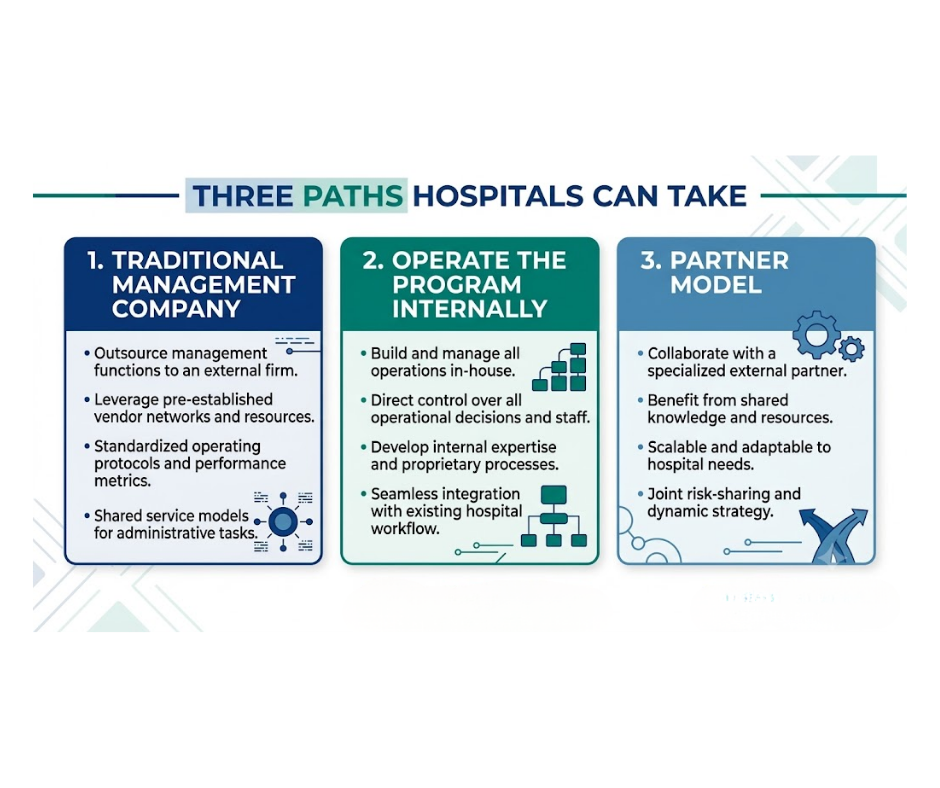
Three Paths Hospitals Can Take
When evaluating a strategic partner, hospitals have three options.
1. Traditional Management Company
Traditional management models can provide some infrastructure and expertise, but they often require hospitals to relinquish varying degrees of control over operations, technology, staffing, and strategic direction.
For some organizations, this model continues to provide value but for most organizations, changing priorities create new questions around flexibility, transparency, accountability, and financial performance.
2. Operate the Program Internally
Some hospitals choose complete independence and manage every aspect themselves.
This approach preserves accountability but requires significant internal resources, including expertise in:
Standards of care
Revenue cycle management
Regulatory compliance
Quality reporting
Clinical education
Hyperbaric medicine operations
Program development
Denial prevention
Physician engagement
For many hospitals, maintaining that level of specialization internally can be difficult.
3. Strategic Partner Model
With a strategic partner, the hospital maintains control of its people, equipment, and program while leveraging experienced wound care specialists to strengthen operations, compliance, and financial performance.
Rather than outsourcing the program, hospitals gain access to resources that help them optimize it.
Why More Hospitals Are Reevaluating the Traditional Model
Is not about replacing one company with another. It’s about determining whether your program aligns with the system’s long-term goals.
Accountability Matters
Healthcare systems increasingly want to own their success.
That includes:
Staff and culture
Mission and values strategic decisions
Data and analytics
Referral relationships
Strategic partnerships allow hospitals to build sustainable programs that reflect the unique needs of their communities.
PILLARS OF A STRATEGIC PARTNERSHIP
Visibility: Drives Better Decisions
Hospital executives need access to meaningful information. Questions such as:
How is the Wound Center performing?
How integrated is the Wound Center
Which referral sources are growing?
Where are revenue opportunities being missed?
Modern programs require actionable data. When leadership has visibility into operations, programs can respond faster and make more informed decisions.
Compliance: Continues to grow in complexity
Wound care and hyperbaric medicine programs operate within an increasingly complicated regulatory environment. Organizations must navigate:
Documentation requirements
Coding changes
Medical necessity and standards of care
Audit preparedness
Revenue integrity
Quality reporting
Small issues can quickly translate into denials, lost revenue, and increased risk.
Having experienced specialists focused on compliance can strengthen both financial performance and operational confidence.
Financial Performance: Is More Than A Volume Problem
Growing patient volume is important, but sustainable success depends on operational excellence. High-performing programs focus on:
Patient Care
Quality Outcome
Standardized systems and processes
Revenue cycle optimization
Referral development
Physician engagement
Workflow efficiency
Staff education
Improving these areas often produces meaningful financial gains without increasing overhead.
What Does the WoundCentrics Approach Look Like?
WoundCentrics was built around a simple philosophy:
Hospitals should own their wound care program, while having access to world-class expertise.
Instead of managing the program for you, WoundCentrics supports your team through:
Regulatory and Compliance Support, operational expertise, and financial stewardship
Helping organizations stay ahead of changing requirements while strengthening documentation and reducing risk.
Revenue Cycle Optimization
Improving charge capture, minimizing denials, and identifying opportunities to enhance financial performance.
Clinical Education
Supporting physicians, providers, and staff with ongoing education and evidence-based best practices.
Technology and Analytics
Delivering greater visibility into operational and clinical performance.
Program Development
Helping hospitals strengthen referral networks, improve workflows, and expand access to advanced wound care services.
Workforce Development
Supporting recruitment, onboarding, and training to build sustainable teams.
Hyperbaric Medicine Expertise
Providing guidance across operations, quality, and growth opportunities.
Transition Doesn't Have to Mean Disruption
Many healthcare leaders assume that changing program structures would create instability.
The reality is that thoughtful planning minimizes disruption.
Successful transitions focus on:
Maintaining continuity of care
Supporting physicians and staff
Preserving patient access
Strengthening compliance infrastructure
Optimizing workflows
Building long-term sustainability
When approached strategically, change becomes an opportunity to strengthen the program—not interrupt it.
Better Questions to Ask:
What structure best supports our mission, our patients, and our community over the next decade?
For some organizations, maintaining the current arrangement remains the right choice.
For others, a support partner model offers a path that combines ownership, expertise, transparency, and long-term growth.
Because ultimately, the goal isn't to outsource wound care.
It's to build a stronger wound care program.
What are my options?
Hospitals typically have three options: remain with their current management company, operate the program independently, or partner with an organization that provides support while preserving hospital ownership.
Can a hospital run a wound care program without a management company?
Yes. Hospitals can operate independently or partner with organizations that provide expertise without assuming ownership of the program.
Are hyperbaric chambers difficult to replace?
Not necessarily. Hospitals have multiple options, including leasing and purchasing equipment, and transitions can often occur without disrupting patient care.
How can hospitals improve wound center profitability?
Financial performance is often improved through stronger documentation, denial prevention, revenue cycle optimization, workflow improvements, and referral development rather than simply increasing patient volume.
What does WoundCentrics do?
WoundCentrics helps hospitals strengthen wound care and hyperbaric medicine programs through consulting, compliance support, education, technology, revenue cycle optimization, and operational expertise while allowing hospitals to maintain ownership and control.
How do we build our own program?
Healthcare is changing. Wound care programs should evolve with it.
WoundCentrics partners with hospitals to improve outcomes, strengthen compliance, optimize financial performance, and create sustainable programs designed around the needs of each organization—not a one-size-fits-all model.
Because your wound center should work for your hospital—not the other way around.