
Successful Programs Go Beyond the Clinic
Is Your Wound Center Sustainable?
Five years from now, will your wound center be thriving?
That is the strategic question more hospital leaders should be asking.
Strong schedules, favorable reimbursement, and steady referral activity can create the impression that a wound center is healthy. But sustainability is measured over years, not quarters. A program can be busy today and still be vulnerable tomorrow if it is not integrated into the health system, supported by a stable workforce, connected to the community, and positioned to adapt as healthcare changes.
The environment surrounding wound care continues to evolve. Workforce shortages persist. Referral patterns shift. Reimbursement pressure intensifies. Technology advances. Patient complexity increases. Programs that succeed long term are not simply well-run clinics. They are strategic assets that support the broader mission of the hospital.
At WoundCentrics, we believe sustainability is not an endpoint. It is a strategy.
Sustainability Is More Than Clinic Performance
Financial performance matters. Operational discipline matters. Documentation and compliance matter. But those areas alone do not define sustainability.
The strongest wound programs are built to create value beyond the four walls of the clinic. They support physician alignment, strengthen service-line integration, improve access for high-risk patients, contribute to population health goals, and help hospitals protect patients from avoidable complications.
A sustainable wound program should be able to answer questions such as:
Is wound care connected to the hospital’s broader clinical strategy?
Are key service lines actively engaged in wound care pathways?
Are referral relationships growing, diversified, and durable?
Do we have the workforce depth to maintain continuity during turnover or growth?
Are we improving care for high-risk patients across the continuum?
Are we positioned to adapt to new technologies, reimbursement models, and patient needs?
Programs that can answer these questions confidently are better positioned to withstand disruption and remain relevant over time.
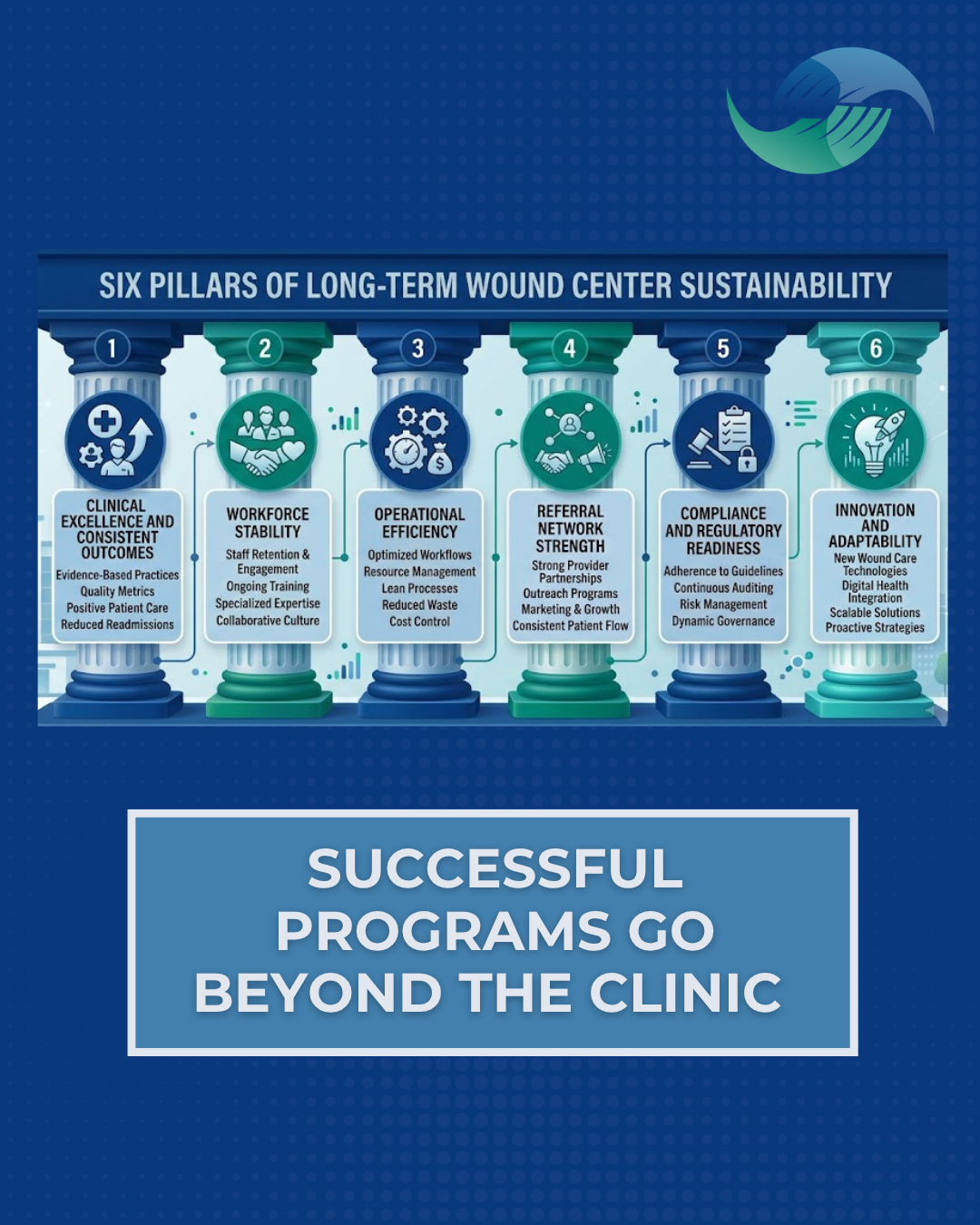
Six Pillars of Long-Term Wound Center Sustainability
1. Clinical Excellence and Consistent Outcomes
Quality outcomes remain the foundation of every successful wound program.
Healing rates, appropriate utilization, documentation quality, patient experience, and adherence to evidence-based care all contribute to long-term viability. A program that cannot consistently demonstrate quality will eventually struggle to maintain physician confidence, patient trust, and executive support.
Clinical excellence requires more than skilled providers. It requires repeatable systems, continuing education, outcome measurement, peer review, and a culture of improvement. Standards evolve. Patient complexity changes. Treatment options expand. Sustainable programs invest in the clinical infrastructure necessary to keep pace.
Key indicators include:
Healing outcomes and time-to-heal performance
Appropriate utilization of advanced treatment modalities
Consistency in assessment, documentation, and care planning
Patient access and patient experience
Provider education and adherence to evidence-based practice
Clinical excellence creates credibility. Credibility creates confidence. Confidence supports long-term growth.
2. Workforce Stability
Healthcare staffing challenges continue to affect every specialty, and wound care is no exception.
Provider turnover, recruitment difficulty, employee burnout, and leadership transitions can quickly disrupt access, consistency, referral confidence, and financial performance. A program that depends too heavily on one physician, one nurse, or one operational leader carries significant risk.
Sustainable programs prepare for workforce instability before it occurs. They create team depth, support role clarity, invest in education, and develop coverage strategies that preserve continuity of care.
Important workforce strategies include:
Cross-training clinical and support staff
Provider onboarding and continuing education
Succession planning for key roles
Coverage models that protect patient access
Leadership development and accountability structures
Standardized workflows that reduce dependence on individual workarounds
Organizations that develop teams create resilience. Organizations that depend on individuals create vulnerability.
Exceptional care should not require extraordinary effort.
Successful wound centers continuously evaluate workflows, scheduling, documentation processes, coding accuracy, and throughput.
Small inefficiencies compound over time. Efficient operations improve patient access, reduce staff frustration, and strengthen financial performance.
Operational excellence creates capacity for growth.
3. Health System Integration
The most sustainable wound programs are not standalone clinics.
They are integrated into the broader health system.
Wound care intersects with multiple service lines, including vascular surgery, podiatry, endocrinology, infectious disease, orthopedics, emergency medicine, rehabilitation, case management, care coordination, and post-acute care. When wound care is disconnected from these areas, patients experience fragmented care and programs miss opportunities to create broader organizational value.
Integrated wound programs support clinical pathways that improve access, reduce delays in treatment, and strengthen continuity for complex patients. They also help hospitals identify opportunities to reduce avoidable utilization and improve outcomes across the continuum.
Executive teams should ask:
Is wound care included in service-line planning?
Are vascular, podiatry, endocrinology, and infectious disease pathways clearly defined?
Are inpatient, outpatient, and post-acute transitions coordinated?
Are wound-related complications being tracked across the organization?
Is the program contributing to limb preservation, readmission reduction, and avoidable admission strategies?
Do hospital leaders understand the program’s impact beyond direct clinic revenue?
Programs that become strategically embedded within the health system are more resilient than programs operating in isolation. They are not simply departments. They are part of the hospital’s care delivery strategy.
4. Referral Network Strength
No wound center operates in isolation.
Referral relationships remain one of the strongest indicators of long-term program health. A full schedule may look encouraging, but sustainability depends on whether referral activity is broad, durable, and aligned with the needs of the community.
A program dependent on only a handful of referral sources is vulnerable. Provider retirement, competing programs, access barriers, payer changes, or loss of confidence can quickly affect volume and performance.
Healthy wound programs actively manage referral development. They evaluate where patients are coming from, where patients are being missed, and which relationships require continued education and engagement.
Referral network strength should be evaluated across:
Primary care and internal medicine
Podiatry and vascular surgery
Endocrinology and diabetes care
Infectious disease and orthopedic providers
Emergency departments and inpatient discharge planners
Post-acute providers and community-based clinicians
Employer, payer, and community access channels where appropriate
Strong referral networks are not built through passive awareness. They are built through responsiveness, outcomes, communication, education, and trust.
5. Compliance and Regulatory Readiness
Sustainable wound programs do more than treat wounds.
They improve the health of the communities they serve.
Chronic wounds are commonly associated with diabetes, peripheral arterial disease, neuropathy, immobility, infection risk, and other complex medical conditions. These patients often require coordinated care across multiple settings. When wound care programs are positioned strategically, they can help hospitals address high-risk populations more effectively.
As healthcare continues to move toward value, access, and measurable outcomes, wound programs should be evaluated not only by clinic activity but also by their impact across the continuum of care.
Potential areas of community and population health impact include:
Reducing avoidable hospital admissions related to wound complications
Preventing readmissions through timely follow-up and care coordination
Supporting limb preservation initiatives
Improving access for patients with diabetes, vascular disease, and mobility limitations
Reducing avoidable emergency department utilization
Identifying barriers to care before wounds deteriorate
Supporting health-system strategies for complex chronic disease management
The most successful programs measure not only what happens inside the clinic, but also the value they create for patients, hospitals, and communities. When wound centers are recognized as contributors to population health rather than simply procedural service lines, they become strategically indispensable.
6. Innovation and Adaptability
Healthcare changes too quickly for wound programs to remain static.
Emerging technologies, advanced diagnostics, artificial intelligence, remote monitoring, evolving treatment modalities, new documentation standards, and changing reimbursement models continue to reshape wound care. Programs that wait until change is unavoidable often fall behind. Programs that build adaptability into their model remain competitive.
Innovation does not mean adopting every new product or technology. It means having the discipline to evaluate what improves outcomes, strengthens access, supports documentation, improves visibility, and creates measurable value.
Sustainable programs regularly assess:
New clinical technologies and treatment pathways
Data analytics and performance dashboards
Telehealth, remote monitoring, and access strategies
Patient engagement tools
Advanced diagnostics and risk stratification
New reimbursement and value-based care opportunities
Innovation is not a separate initiative. It is part of long-term sustainability.
Sustainability Is Built Long Before Problems Appear
Most wound programs do not struggle overnight. Warning signs usually appear long before performance declines.
Common early indicators include:
Provider burnout or declining engagement
Referral concentration or declining referral diversity
Weak alignment with hospital service lines
Limited leadership visibility into program performance
Staffing instability or lack of succession planning
Reduced community awareness or access barriers
Slow adoption of technology, analytics, or updated care models
The strongest organizations identify these risks early and act before they become operational, financial, or clinical problems. Sustainability is not about protecting the status quo. It is about building a program that can continue to improve as conditions change.
A Strategic Question Every Hospital Should Ask
If your wound center looked exactly the same five years from now, would that be considered success?
For most hospitals, the answer should be no.
A sustainable wound program should become more integrated, more visible, more coordinated, more data-driven, and more valuable to the organization over time. It should strengthen referral relationships, improve access for complex patients, support community health needs, and contribute to the hospital’s broader clinical and strategic goals.
Long-term sustainability does not happen by accident. It happens by design.
At WoundCentrics, we partner with hospitals and healthcare organizations to help build wound programs designed not only to perform today, but to remain strong for years to come.
Ready to Assess Your Program?
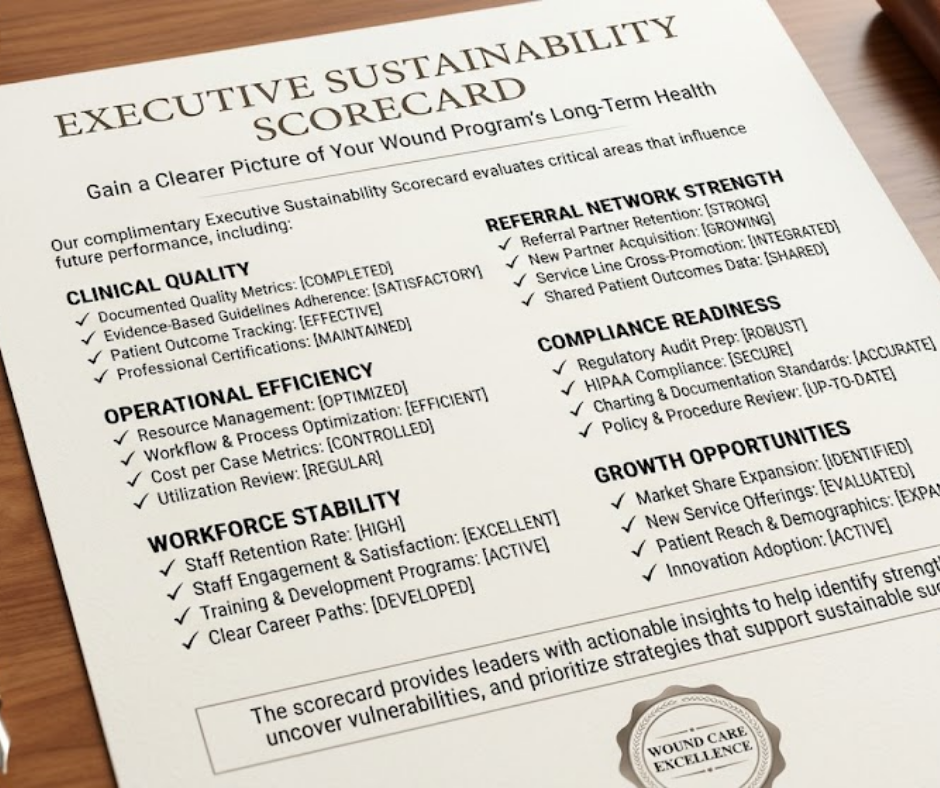
Executive Sustainability Scorecard
Gain a clearer picture of your wound program’s long-term health.
The WoundCentrics Executive Sustainability Scorecard helps leaders evaluate critical areas that influence future performance, including:
Clinical quality and outcomes
Workforce stability and provider continuity
Health system integration
Referral network strength
Community impact and population health alignment
Innovation, adaptability, and future growth opportunities
The scorecard provides actionable insight to help leaders identify strengths, uncover vulnerabilities, and prioritize strategies that support sustainable success.
Request Your Complimentary Executive Sustainability Scorecard
Frequently Asked Questions
What makes a wound center sustainable?
A sustainable wound center consistently delivers quality outcomes while remaining integrated with the health system, supported by a stable workforce, connected to referral partners, responsive to community needs, and prepared to adapt as healthcare changes.
Why do wound centers struggle over time?
Common challenges include provider turnover, referral concentration, weak service-line integration, limited performance visibility, access barriers, and failure to adapt to changing clinical, financial, or market conditions.
Why should wound programs go beyond the clinic?
Wound care patients often require support across multiple settings and specialties. Programs that connect with hospital service lines, community providers, and care coordination teams are better positioned to improve outcomes and create broader organizational value.
How can hospitals improve wound center sustainability?
Hospitals can strengthen sustainability by investing in clinical quality, workforce development, health-system integration, referral strategy, population health alignment, data visibility, and innovation.
Why is workforce stability important in wound care?
Provider continuity and team development help maintain patient access, preserve institutional knowledge, improve consistency, and reduce disruption caused by turnover.
How often should wound programs evaluate sustainability?
Wound programs should regularly review clinical outcomes, workforce stability, referral trends, health-system integration, community impact, and future growth opportunities to identify risks before they affect performance.