
Peptides in Wound Healing: Promising Signals, Premature Practice
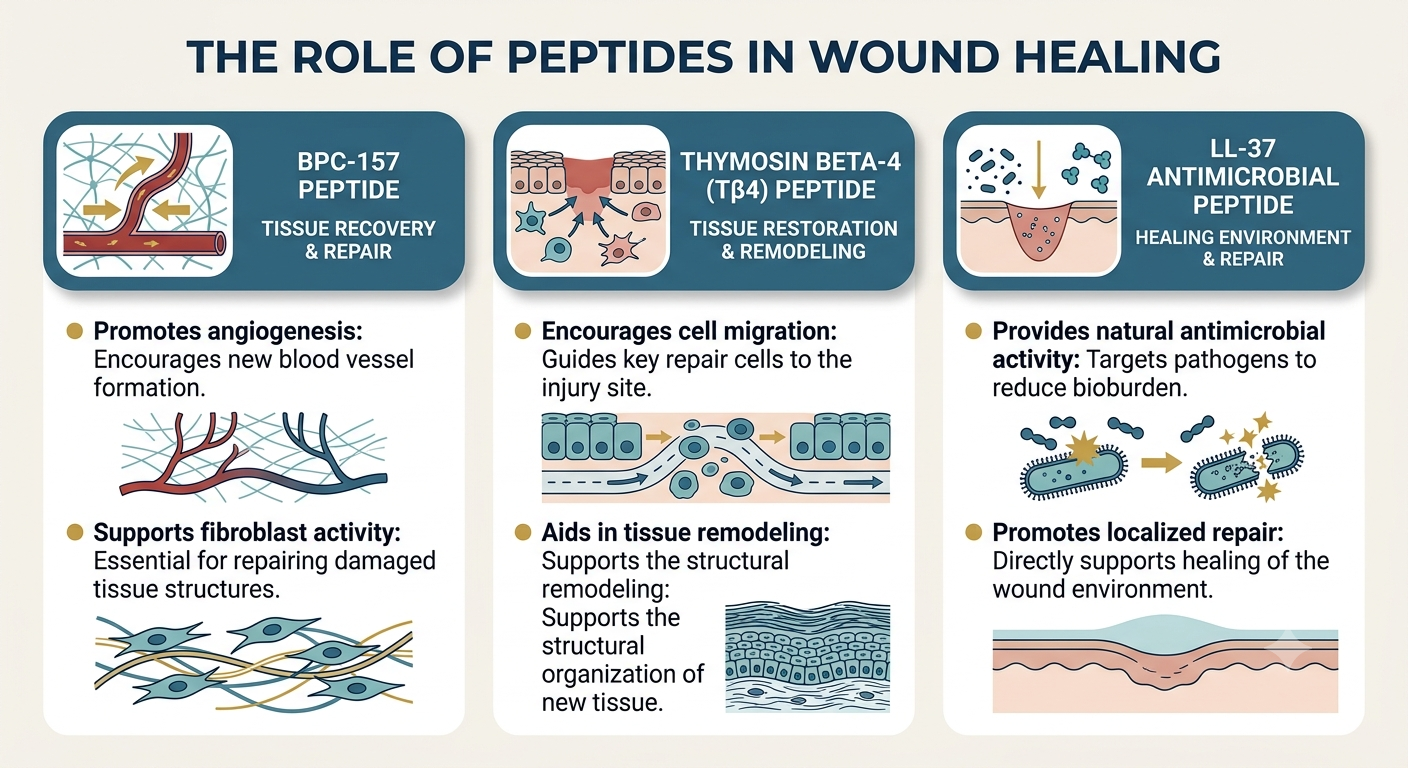
Peptides — short chains of amino acids that act as signaling molecules rather than direct treatments — are one of the most talked-about topics in wound care right now, showing up in patient questions, LinkedIn feeds, and conference hallways. Peptides such as BPC-157, thymosin beta-4, and LL-37 influence processes central to healing, including cell migration, angiogenesis, collagen production, and antimicrobial defense. However, most of the supporting evidence remains preclinical, drawn from animal and lab-based studies, with human trials that are small, limited, and not standardized. No established dosing guidelines, delivery methods, or long-term safety data currently exist. WoundCentrics’ position is that peptides may eventually earn a role as an adjunct therapy for non-healing wounds, but they are not yet appropriate as a first-line or standalone treatment, and the fundamentals of evidence-based wound care must remain the priority.
What Are Peptides, and Why Is Everyone Suddenly Talking About Them?
Peptides are short chains of amino acids that function as signaling molecules in the body. In wound healing, they do not act as direct treatments in the way a topical antimicrobial or a skin substitute does. Instead, they behave more like messengers, sending biochemical instructions that influence how the body carries out key steps in the healing process, including cell migration, angiogenesis, collagen production, and inflammation.
That messenger role is exactly why peptides are generating so much interest. Chronic wounds frequently stall in the inflammatory phase of healing, and the theoretical appeal of peptides is that they may help re-signal or reset a stalled wound environment so it can progress through the healing cascade. It is a compelling hypothesis, and it explains why patients are asking about peptides and why they are a fixture of the current wound care conversation. A compelling mechanism, however, is not the same as a proven clinical benefit.
Which Peptides Are Clinicians Most Likely to Hear About?
Three peptides account for most of the current attention in wound care circles:
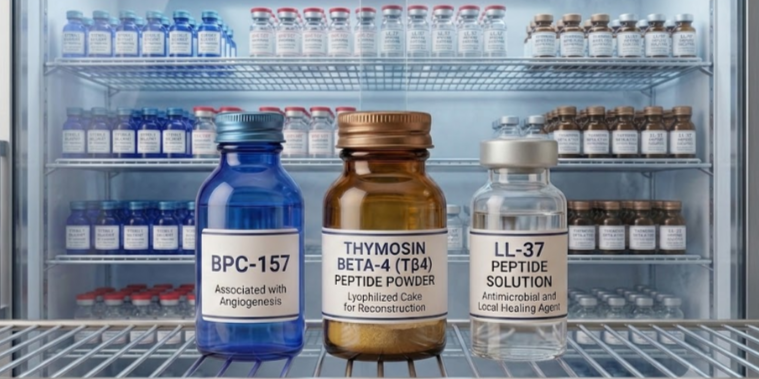
• BPC-157 — associated with angiogenesis and fibroblast activity, but this signal is drawn mostly from animal studies rather than controlled human trials (Frontiers in Pharmacology).
• Thymosin beta-4 — implicated in cell migration and tissue remodeling, with some limited human data from small phase 2 trials in pressure ulcers and epidermolysis bullosa wounds (PubMed; ClinicalTrials.gov NCT00311766).
• LL-37 — a naturally occurring antimicrobial peptide that may help reduce bioburden while supporting healing (PMC).
The important caveat applies across all three: a plausible mechanism of action does not equal a proven clinical outcome. Understanding what a peptide does in a petri dish or an animal model is a very different question from knowing whether it improves healing rates safely in your patients.
Does Current Evidence Support Clinical Use?
Right now, most of the evidence supporting peptide use in wound care is preclinical — animal or lab-based. Human trials that do exist are limited in number, often small in size, and not standardized across dosing, formulation, or wound type. Just as significant, the field lacks clear dosing guidelines, established delivery methods, and long-term safety data.
That combination of factors means peptide therapy, however promising in concept, is not yet a well-established treatment. Clinicians should treat peptides the same way they would any emerging modality without a robust evidence base: interesting to monitor, not yet appropriate to lean on.
Why the Fundamentals of Wound Care Still Come First
Before any adjunctive therapy — peptides included — enters the conversation, the fundamentals of wound care have to be optimized: perfusion, offloading, infection control, debridement, and moisture balance. No adjunctive therapy can overcome gaps in standard care. A wound that is not adequately offloaded, debrided, or perfused will not respond meaningfully to an experimental signaling molecule layered on top of unaddressed basics.
This is also where clinical judgment protects patients from costs and risks without corresponding benefits. If the fundamentals are not yet optimized, that is the priority — not the next emerging adjunct.
What Should You Tell Patients Who Ask About Peptides?
Patients arrive having seen peptides discussed on social media or heard about them from other patients, so it is worth preparing a clear, consistent response. Two things matter most in that conversation:
Set realistic expectations and be explicit about the difference between evidence and anecdote. A compelling mechanism or an enthusiastic testimonial is not the same as a controlled clinical trial.
Flag safety and sourcing concerns. Many peptide products marketed directly to consumers are not clinically regulated in the same way as approved pharmaceuticals, which raises real questions about purity, dosing accuracy, and manufacturing standards.
Educating patients on both points respects their interest in emerging options while keeping the conversation grounded in what can actually be supported today.
Where Might Peptides Fit in the Future of Wound Care?
Peptides may eventually find a role as adjunct therapies, particularly for wounds that have failed to respond to standard treatment, or within controlled clinical or research environments where outcomes can be measured rigorously. What they are not, at this stage, is a first-line or standalone treatment. That distinction matters for any clinical team building or updating a wound care protocol: an emerging adjunct under investigation is a different category of decision than an established standard of care.
Where WoundCentrics Stands on Peptide Therapy Today
WoundCentrics evaluates emerging modalities the same way it evaluated vitamin K, cellular and tissue-based products, and every other addition to its clinical protocols: by following the strength of the evidence, not the volume of interest. Peptides are a legitimate area of ongoing research, and WoundCentrics’ physician-led teams stay current on the literature as it develops. Until controlled human trials establish clear efficacy, dosing, and safety data, however, WoundCentrics continues to anchor calciphylaxis, diabetic foot ulcer, pressure injury, and venous wound protocols in evidence-based fundamentals — perfusion optimization, offloading, infection control, debridement, and moisture balance — across the more than 100 facilities it serves nationally.
Facilities looking to strengthen their evidence-based wound care protocols can learn more abouthow WoundCentrics builds physician-led wound care protocols.
The Bottom Line for Wound Care Teams
Peptides are promising, but the evidence is still evolving, and they are not currently part of standard wound care practice. As clinicians, the responsibility is to stay informed while remaining grounded in evidence-based care — the fundamentals will always matter most. If peptides become part of the future of wound care, it will be because strong clinical evidence supports their use, not because of hype. Until then, the focus stays on delivering high-quality, evidence-based care.
Frequently Asked Questions
Q: What are peptides, and how are they different from a standard wound care treatment?
A: Peptides are short chains of amino acids that act as signaling molecules rather than direct treatments. In wound healing, they influence processes like cell migration, angiogenesis, collagen production, and inflammation, functioning more like messengers than active therapeutic agents.
Q: Which peptides are getting the most attention in wound care?
A: BPC-157, thymosin beta-4, and LL-37 are the three most frequently discussed. BPC-157 is linked to angiogenesis and fibroblast activity in animal studies, thymosin beta-4 has limited human data on cell migration and tissue remodeling, and LL-37 is an antimicrobial peptide that may help reduce bioburden.
Q: Is there strong clinical evidence supporting peptide use in wound care?
A: Not yet. Most current evidence is preclinical, based on animal or lab studies. Human trials are limited, often small, and not standardized, and there are no established dosing guidelines, delivery methods, or long-term safety data.
Q: Should peptides be used as a first-line or standalone wound treatment?
A: No. Peptides are not appropriate as first-line or standalone treatments at this stage. They may eventually serve as adjunct therapies for wounds that fail to respond to standard treatment, or within controlled clinical and research settings.
Q: What should come before considering peptide therapy for a patient?
A: The fundamentals of wound care must be optimized first: perfusion, offloading, infection control, debridement, and moisture balance. No adjunctive therapy, including peptides, can overcome gaps in standard care.
Q: What should clinicians tell patients who ask about peptides?
A: Set realistic expectations by clearly distinguishing evidence from anecdote, and raise safety and sourcing concerns, since many peptide products marketed to consumers are not held to the same regulatory and manufacturing standards as approved pharmaceuticals.
Talk to WoundCentrics About Evidence-Based Wound Care Protocols
Emerging therapies like peptides deserve attention, but patient outcomes depend on protocols grounded in robust evidence and clinical fundamentals. If your hospital, LTACH, or wound center wants physician-led guidance on building or refining evidence-based wound care protocols, contact WoundCentrics to speak with a member of our clinical leadership team.
Sources
• Stable Gastric Pentadecapeptide BPC 157 and Wound Healing, Frontiers in Pharmacology
• Thymosin β4 Promotes Dermal Healing, PubMed
• The Human Cathelicidin Antimicrobial Peptide LL-37 as a Multifunctional Effector Molecule, PMC